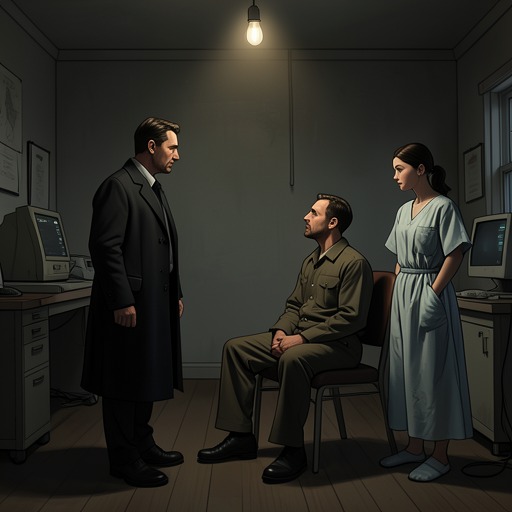
Scott Duncan arranges to slip the photograph into Grace’s film envelope
Just One LookScott Duncan arranges to slip the Mystery photograph into Grace Lawson’s film envelope as part of a deliberate effort to provoke a response from the person he suspects. The placement is not an accidental discovery: Duncan paid Josh at Photomat to put the picture in Grace’s envelope, turning an ordinary film-processing transaction into a concealed investigative tactic. When Grace identifies the arrangement, the photograph becomes evidence not only of the mystery surrounding it but also of Duncan’s willingness to manipulate what she sees and whom she suspects.
The Arrangement at Photomat
Grace tells Duncan that she checked with Josh at Photomat. Duncan’s immediate question is how much she paid him; Grace answers that she paid $1,000. Duncan replies that he had paid Josh only $500 to put the picture in her envelope. The exchange establishes the central mechanics of the action: Duncan had already arranged the insertion, and Josh was the person who carried it out.
The difference between the two sums sharpens the confrontation without changing what the evidence establishes. Grace has paid twice what Duncan says he paid, but the conversation does not explain why she paid that amount or what Josh did with either payment. What it does make clear is that the photograph’s arrival in her envelope was engineered in advance. Duncan’s terse confirmation closes off the possibility that he is merely speculating about the placement: he acknowledges having commissioned it.
Provocation and Surveillance
The insertion belonged to a broader strategy that Grace names as shaking the cage. She accuses Duncan of casting suspicion on Cora to distract her from pressing Josh. The photograph’s placement and the suspicion directed toward Cora thus function together in Grace’s account: one creates a planted clue for her to investigate, while the other diverts her attention from the person who could confirm how the clue got there.
Grace also connects the photograph to Duncan’s efforts to observe the suspect’s reactions. He insisted that she accompany him to see Evelyn Alworth, and Grace now understands that he wanted to see Evelyn’s response to Emma and Max. That visit was another provocation, not simply a family encounter. Grace says that Evelyn’s condo was directly on Jack Lawson’s route to work and recognizes that this placement, too, had significance within Duncan’s investigation.
Duncan’s capacity to monitor the suspect had changed. Because he had been forced to take leave, he could not use the FBI for surveillance. Grace says he therefore hired a private detective, the investigator who used Rocky Conwell, and arranged for a camera to be placed in her house. She explains the logic: if Duncan meant to shake the cage, he needed to see how his suspect reacted. The hidden photograph was one element in this larger pattern of staged pressure and observation, alongside the visit to Evelyn, the private detective, and the camera.
Disclosure and Cost
The action is finally disclosed through Grace’s reconstruction rather than through a scene showing Duncan making the arrangement. In their conversation, separate details converge: her inquiry at Photomat, the money paid to Josh, Duncan’s admission, the suspicion directed toward Cora, and the surveillance surrounding Jack’s route and Grace’s home. This delayed explanation changes the photograph from an unexplained object into a tool in Duncan’s investigation, and changes Grace’s understanding of his earlier behavior from puzzling to purposeful.
That understanding does not resolve the moral cost of the scheme. After Duncan agrees that her account of the surveillance is true, Grace turns to its result and tells him that many people died because of what he did. Her judgment places the planted photograph within a chain of consequences larger than the trick itself. Duncan’s methods may have been designed to expose a suspect by provoking a reaction, but the conversation ends by measuring them against the deaths Grace associates with his actions. The photograph’s significance therefore lies both in what it reveals about Duncan’s investigation and in the danger of treating people’s lives and suspicions as instruments for shaking the cage.